
Stuffed Japanese Eggplant Recipe (Naturally Vegan and Gluten-Free)
My stuffed Japanese eggplant recipe tastes as good as it looks. These mild and slightly sweet vegetables are just delicious when stuffed with garlic, onion, sweet peppers, tomato and parsley, and then baked with the skin on.
I didn’t go out looking to make Japanese eggplant recipes. When I was at the farmer’s market the other day, I happened to pick up some nice, long Japanese eggplants. In the past, I’ve used these to make a sweet and sour or miso stir fry.
This time, I wanted to bring out the eggplant flavor a little more so I experimented by stuffing them with sweet peppers and tomatoes that I also purchased at the farmers market!

After trying my stuffed eggplant recipe, no one in my family missed the usual cheese or heavy soy sauce from the other dishes!
What is Japanese Eggplant?
Japanese eggplants are a slender variety of eggplant with a distinctive purple skin. The skin is delicate, soft and tender, so I like to cook them with the skin on. I also love them for their mild and slightly sweet flavor profile!
How Does It Differ From a Regular Eggplant?
Compared to your regular eggplant, which is quite bulbous and shaped like a teardrop, Japanese eggplants are much narrower. The diameter is closer to that of a cucumber than a globe eggplant!
The skin also feels very different. It’s much thinner than your regular eggplant, which is why Japanese eggplants are so tender and also tend to absorb the salt or other flavorings you coat them in.
Another key difference is that the Japanese eggplant has virtually no seeds. In a normal eggplant, there are plenty of seeds, and these can make the taste slightly more bitter. Japanese eggplants instead have a milder and sweeter flavor without any bitterness.
Why You’ll Love This Stuffed Japanese Eggplant Recipe
- It’s naturally vegan and gluten-free. You don’t need to make any last-minute swaps to make it suit your diet. All of the ingredients in this dish are fully plant-based and have no added gluten.
- It’s full of flavor. Roasting the eggplant, garlic, onions, parsley and sweet pepper invites all of the subtle and mouthwatering flavors to develop and mingle together.
- It’s lighter than Japanese eggplant recipes with cheese or soy sauce. I have used Japanese eggplants for sweet and sour or miso stir fries, which tend to feel heavier in the stomach. This recipe is much lighter, especially if you pair it with a salad.
Key Ingredients in This Recipe

- Japanese eggplant is the key ingredient. They can be hard to buy, so if you cannot find Japanese eggplant, you can use Chinese eggplant instead. This variety has a similarly long shape (about six to 10 inches) and a sweet taste.
- Olive oil is used firstly to sauté the onion, garlic and veggies and secondly to fry the eggplants before everything goes in the oven.
- Tomatoes and sweet peppers work so well in my stuffed eggplant recipe. For tomatoes, I use both diced tomato and also add tomato sauce to the baking tray.
- Garlic and onion are bursting with flavor and therefore perfect for this dish.
- Parsley adds a lovely earthy and almost peppery finish.
Step‑by‑Step Instructions
To begin my stuffed Japanese eggplant recipe, first prepare the eggplants by peeling them into stripes (without removing the tops) and salting the exterior generously. Then, leave them alone for 45 minutes.
While they rest, sauté the onions, sweet peppers and garlic (the whole cloves!) in a deep pan until the onion turns transparent. Then, add the finely diced tomatoes, chopped parsley, salt, pepper and sugar to the same pan and sauté them for about five more minutes.
That’s your filling done. After setting it aside to cool, wash the peeled eggplants and pat them dry. Then, fry them until they’re golden brown, taking care to slice them about halfway through (not all the way – they should look like canoes!).
In a baking dish, add the eggplants and stuff them equally with the filling. The final step is to pour the tomato sauce into the baking pan and cover them with aluminum foil (a few slits are recommended to give the steam an escape route). The stuffed eggplants will take about 45 minutes to bake in a pre-heated oven at 350°F.
Tips for the Best Results
- Do not chop the tops off the eggplant. They really help to hold the shape of the eggplant, which makes stuffing easier and also makes the finished product look pretty and well put together!
- Let the eggplant rest for 45 minutes before baking. This gives time for the salt to pull water out of the eggplant’s cells. When the eggplant is cooked, it’ll bake instead of steam. The payoff is a baked eggplant that’s not spongy or greasy, and sweeter in taste.
Storage & Reheating
The leftovers for these vegan stuffed Japanese eggplants can be saved for up to three days if you store them in an airtight container in the refrigerator.
When you’re ready to tuck in again, you can reheat them in the microwave if you’re short on time or warm them up in a pan over the stovetop.
Serving Suggestions
- Keep it simple with rice. Fluffy white rice will soak up the tomato and juices from the pan (it’s simple but delicious!). Alternatively, if you’re craving a bit of heat, you could pair the stuffed eggplants with one of my spiced rice recipes such as my curried roasted vegetable rice.
- Serve them as part of a spread. These stuffed Japanese eggplants are honestly perfect for a spread. Put them together alongside other baked vegetarian side dishes, like oven-roasted cabbage wedges with mustard sauce or my garlicky roasted broccoli recipe.
- Serve with bread. Crusty breads are a nice contrast to the soft and tender eggplant. You might want to try it with my vegan keto seeded bread where seeds add some nice crunch (and healthy fats).
- Pair it with a fresh salad. For a light lunch, you can always bring out one of my vegetarian salad recipes too.
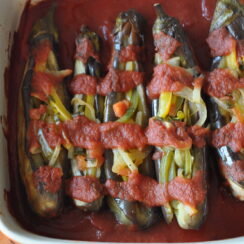
Stuffed Japanese Eggplant Recipe (Naturally Vegan and Gluten-Free)
Ingredients
- 4 long purple Japanese eggplants
- 8 tablespoons olive oil, (divided)
- 10 cloves garlic, (peeled)
- 1 large onion, (sliced thinly)
- 2 sweet peppers, (sliced thinly)
- 1 large tomato, (diced)
- 1 cup parsley, (chopped)
- Salt, (to taste)
- 1/2 teaspoon sugar
- Freshly ground black pepper, (to taste)
- 1 cup tomato sauce
Instructions
- Preheat oven to 350 °F.
- Peel eggplants in stripes, salt exteriors generously, and set aside for 45 minutes. Do not chop tops off to help hold shape of the eggplant.
- Pour 4 tablespoons olive oil into a deep saute pan.
- Add onions, whole cloves of garlic, and sweet peppers and saute until onion is transparent, stirring frequently to prevent browning of onions and garlic.
- After the onions are cooked, add finely diced tomatoes, chopped parsley, salt, pepper, and sugar to the pan and cook for another 5 minutes.
- Turn the heat off, cover, and let cool.
- Wash peeled eggplants and dry them using a paper towel or kitchen towel.
- Heat 4 tablespoons olive oil in a pan, fry eggplants on each side until golden brown (about 1-2 minutes), then place in baking dish to cool.
- Slit opening in the middle of eggplants halfway through. Do not cut all the way through; they should look like canoes.
- Divide filling among four eggplants, stuffing well.
- Pour tomato sauce into baking pan and cover with aluminum foil, making several slits in foil to let steam escape.
- Bake until eggplants are fully cooked. (about 45 minutes).
- Serve immediately.
BON APPÉTIT!
Nutrition
FAQs
The best way to cook Japanese eggplant is to stuff it and roast it in the oven with ingredients like tomatoes, sweet peppers, garlic, onion and parsley. It also works well when pan-fried or grilled, as it has a thinner skin than regular eggplants.
I salt and rest the Japanese eggplant for 45 minutes before frying and roasting it. This helps to draw out moisture and produce a tender (not spongy) texture that’s mild and sweet.
While regular eggplants are thick and teardrop-shaped, Japanese eggplants are narrower and shaped more like a cucumber. The skin of Japanese eggplants is thinner and more delicate, and it also has significantly fewer seeds, making them not only less bitter but also milder and sweeter in flavor than regular eggplants.

Nutrition Disclaimer
Nutrition information is an estimate provided as a courtesy and may vary depending on ingredients used. This content is not intended as medical or dietary advice.